
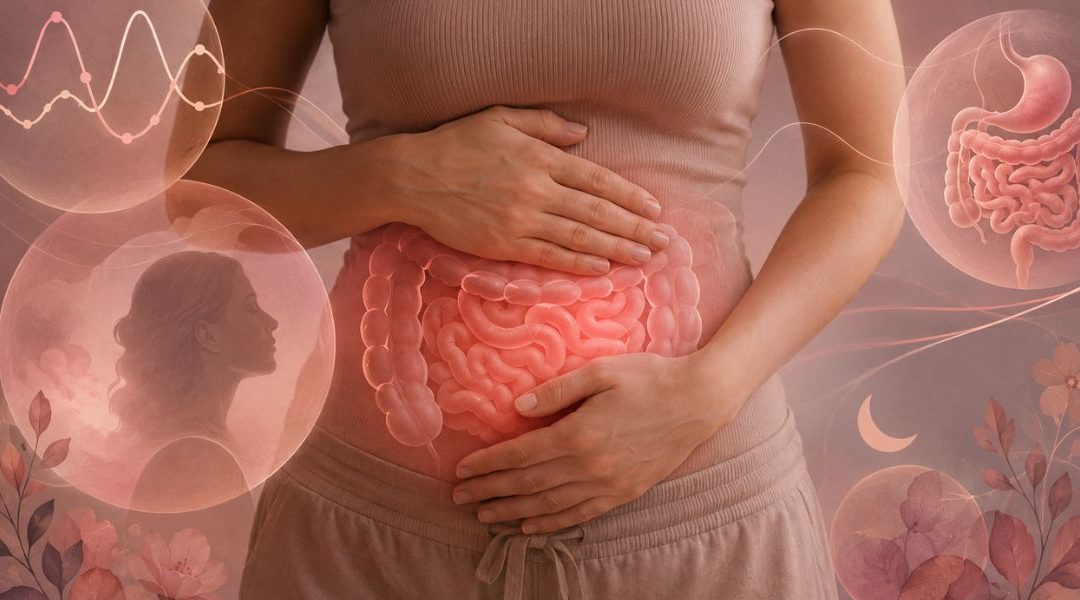
The Forgotten Hormone Connection No One Warned You About
You haven’t dramatically changed what you eat. Yet suddenly your stomach seems to have a mind of its own.
You might wake up feeling fine, but by the afternoon, your waistband feels much tighter. Foods you’ve always eaten now leave you bloated. Sometimes you’re constipated for days, and then your digestion suddenly changes again.
Perhaps you’ve even been told:
“It’s probably IBS.”
But what if there’s another piece of the puzzle? Because during perimenopause, it isn’t only your periods, temperature, mood and sleep that can change.
Your gut can change too.
And fascinating new research is revealing something women were rarely told about before:
Your hormones influence your gut, and your gut may influence what happens to some of your hormones.
Welcome to the gut-hormone connection.
“Why am I suddenly so bloated?”
Bloating is one of those midlife symptoms that can feel as though it appeared overnight.
Your jeans feel tighter. Your stomach looks flatter in the morning and dramatically different by evening. You may feel full more quickly, uncomfortable after meals, or convinced that certain foods have suddenly become a problem.
And because these symptoms involve the digestive system, we naturally assume the answer must be something we’ve eaten.
Sometimes it is. But hormonal change may also be part of the picture.
When estrogen and progesterone levels change during menopause, your whole body can be affected, including your gut. You might find that foods you used to digest easily now make you feel bloated, or that your bowel habits are less regular. These changes are common and can feel unsettling, especially if your routine hasn’t changed much.
Studies on menopause and gut health mention symptoms like bloating, stomach discomfort, indigestion, and constipation. Some women may also notice more IBS symptoms during this time.
So if your digestion doesn’t seem to behave the way it did ten years ago, you’re not necessarily imagining it. Your internal environment is changing.
Meet Your Microbiome
Your digestive tract is home to an enormous community of microorganisms. Collectively, this ecosystem is known as your gut microbiome.
These microbes help interact with:
- digestion
- fibre fermentation
- immune function
- the intestinal barrier
- production of certain metabolites
- inflammation
- metabolism
But there’s another link that’s especially important during perimenopause.
Estrogen.
Scientists are increasingly studying the relationship between changing estrogen levels and the gut microbiome during menopause.
This leads us to a key term in women’s hormone health.
Have You Heard of the Estrobolome?
Probably not. Yet you may hear much more about it in years to come.
The estrobolome refers to the collection of gut microbial genes that can metabolise estrogens. To see why this matters, let’s start with your liver.
Your liver processes estrogen and packages some of it for removal from the body, then transports it into the intestine through bile, ready for elimination. But that’s not the end of the process.
Certain gut bacteria can ‘unpack’ some of that processed estrogen, allowing it to become active again. Instead of leaving the body, some may then be reabsorbed and returned to circulation.”
This process forms part of what is called enterohepatic circulation. In simpler language:
Your liver processes and packages estrogen for removal.
Your gut helps determine what happens next.
Some is eliminated. Some may be reactivated and recycled. And the microbes involved in this process collectively form part of your estrobolome.
This doesn’t mean your gut “controls” your estrogen levels, or that changing your microbiome can fix every hormonal symptom. Scientists are still learning more. But it does show us something important:
Hormone health and gut health are far more connected than we once realised.
And It Works Both Ways
This is where it gets even more interesting.
Estrogen can influence the gut environment too. As ovarian estrogen declines through the menopause transition, researchers are investigating changes in microbial composition, intestinal barrier function and microbial metabolites.
So rather than thinking:
Hormones → symptoms
we may need to think more broadly:
Hormones ↔ gut ↔ metabolism ↔ inflammation
It works both ways.
That may help explain why some women notice digestive changes appearing at roughly the same stage of life as hot flushes, sleep problems, brain fog, body-composition changes and other perimenopausal symptoms.
But research in this area is still emerging. There isn’t one recognised “menopause microbiome,” and studies still don’t agree on exactly which bacterial changes occur in every woman.
That difference is important.
Our goal is to keep you informed, not worried by new wellness trends.
What About Constipation?
Constipation is worth paying attention to. Regular bowel movements aren’t simply about feeling comfortable. Your stool is one way your body eliminates waste products, including hormone metabolites processed for excretion.
If you’re constipated, that elimination process is slowed.
That doesn’t mean constipation automatically causes “estrogen dominance”, as you may sometimes read online. The biology behind this is much more complex. But good bowel health remains an important part of overall metabolic, digestive and hormone health.
If you’ve suddenly become constipated during perimenopause, don’t simply accept it as something you have to live with.
Start with the foundations.
Fibre: One of the Simplest Places to Start
We talk about fibre for bowel regularity, but fibre does much more than “keep you regular”.
Different fibres can help feed beneficial gut microbes.
When gut bacteria ferment certain fibres, they produce compounds called short-chain fatty acids.
These microbial metabolites help maintain the intestinal environment and support the gut barrier.
Fibre can also:
- support stool bulk and regularity
- help maintain microbial diversity
- support blood glucose regulation
- contribute to cardiovascular health
- increase satiety or fullness
Instead of focusing on one “superfood,” try to eat a variety of foods.
Think:
vegetables, fruit, legumes, lentils, seeds, nuts and whole grains, according to what your digestive system tolerates.
And increase fibre gradually.
If you suddenly start eating a lot more fibre, like big salads or lots of bran and chia seeds, you might feel even more bloated. It’s better to add fibre slowly. For example, add one new fiber-rich food every few days and let your body adjust before adding more. This gradual change can help you feel more comfortable and give your gut time to adapt.
Don’t Forget Water
Increasing fibre without increasing fluid can sometimes worsen constipation. Your bowel needs adequate hydration to help keep stool soft and easier to pass.
So before buying another expensive gut-health product, ask yourself two very simple questions:
Am I eating enough fibre?
Am I drinking enough water?
Sometimes, the basics matter most.
Do You Need a Probiotic?
Possibly.
But probiotics aren’t a magic fix, and having more bacteria doesn’t always mean your gut is healthier.
Different probiotic strains have different effects, and researchers are now investigating whether particular probiotics, prebiotics and synbiotics could support women during and after menopause. For example, strains within the Lactobacillus and Bifidobacterium groups are some of those currently being studied for their potential benefits in supporting gut and hormone health during this stage of life.
The evidence is promising in some areas, but it is still developing. Before buying the most expensive probiotic, remember that what you eat every day also shapes your gut environment.
Probiotics are like visitors to your gut.
Fibre-rich plant foods feed the community of microbes already living in your gut.
For many women, both conversations matter.
What About IBS?
If your digestive system has always been sensitive, perimenopause can make those symptoms feel even stronger.
Bloating, altered bowel habits and abdominal discomfort can overlap with symptoms experienced by women with irritable bowel syndrome. But don’t automatically label every new digestive symptom “menopause” or “IBS”.
Persistent or significant changes in bowel habits deserve proper medical investigation. Particularly speak to your healthcare professional if you experience symptoms such as:
- blood in your stool
- unexplained weight loss
- persistent or severe abdominal pain
- a significant ongoing change in bowel habits
- persistent vomiting
- difficulty swallowing
- symptoms that repeatedly wake you at night
- unexplained iron-deficiency anaemia
Hormones can influence how you feel. But hormones should never become an excuse to ignore something that needs investigation.
Your Liver and Gut Are a Team
Another reason we talk so often about lifestyle when discussing hormonal wellbeing is this. Your liver and gut don’t operate independently.
The liver helps metabolise hormones and other compounds. The digestive system moves waste toward elimination. The microbiome participates in an extraordinary range of metabolic processes along the way.
Rather than trying a dramatic “detox,” focus on supporting the systems your body already uses. That means focusing on the basics that really help:
Eat plants.
Eat enough fibre.
Drink water.
Move your body.
Prioritise sleep.
Limit excessive alcohol.
Keep your bowels moving regularly. Your body already knows how to detoxify. The goal is to give your body what it needs to work well.
Your Gut-Friendly Perimenopause Checklist
Start simply.
1. Add plants before removing foods
Instead of starting another restrictive diet, add more types of plant foods you can eat.
2. Build fibre gradually
If you suddenly eat much more fibre, you might feel more bloated. Give your digestive system time to adjust. Particularly if you’re increasing fibre.
3. Move every day
Walking and regular physical activity can support normal bowel function and metabolic health.
4. Include fermented foods if you tolerate them
Foods like live yoghurt, kefir, sauerkraut, and kimchi can add variety to your diet, but they aren’t essential and may not suit everyone.
5. Consider probiotics individually
If digestive symptoms are significant, such as ongoing or severe abdominal pain, blood in your stool, unexplained weight loss, persistent changes in bowel habits, or any symptoms that worry you, speak to an appropriately qualified healthcare professional rather than assuming any generic probiotic will solve the problem.
6. Notice patterns
Does bloating worsen after particular foods?
During stressful weeks?
When you haven’t slept?
At certain stages of your menstrual cycle?
After alcohol?
When you’re constipated?
Noticing patterns can help you learn more about your body
The Bigger Perimenopause Picture
This is the key takeaway from our August series.
Your body isn’t made up of separate departments.
Your aching joints aren’t completely separate from changing estrogen.
Your ability to maintain muscle isn’t separate from metabolism and insulin sensitivity.
Your histamine response isn’t completely separate from hormones.
And your gut isn’t separate from hormone metabolism either.
Your body is an interconnected system. That’s why helping women through perimenopause means looking beyond hot flushes. Sometimes, the symptom you notice first isn’t where the problem started. It’s just your body’s way of letting you know something has changed.
A Note From Tracy
If your digestion has changed suddenly in your 40s, don’t assume you’re now “intolerant to everything” or cut out lots of foods right away.
Start by getting curious about what’s happening.
Perimenopause is a time of enormous biological change, and we’re learning more every year about the relationship between our hormones, microbiome, liver, metabolism and digestive health.
The emerging science of the estrobolome is a perfect example. We still don’t know much. But what we do know is another reason not to treat women’s symptoms as separate issues.
At Youfemism, that’s why we talk about whole-body hormone support rather than chasing one symptom at a time.
Your bloating may be telling you something.
Your constipation may be telling you something.
Your changing digestion may be telling you something.
Pay attention to your body. Focus on the basics. And if something feels off, look into it.
Understanding what’s changing is often the first step to feeling like yourself again.
Tracy
Certified Hormone Health Coach | Youfemism
Want some help understanding what your body is telling you?
Explore the Youfemism Knowledge Hub, learn more about supporting hormonal wellbeing naturally, or book a complimentary 30-minute conversation with our resident Menopause Coach. In your 30-minute conversation, you can discuss your current symptoms, ask questions about perimenopause and gut health, and receive some personalised tips to help you start moving forward. This session is a chance to review what’s going on for you, explore practical strategies, and find out what kind of support may suit you best.
You don’t have to figure perimenopause out alone.